Generative Deep Learning: Teaching Machines to Paint, Write, Compose, and Play
Teaching Machines to Paint, Write, Compose, and Play
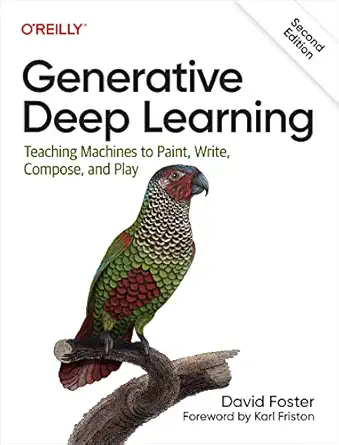
Overview
Generative Deep Learning provides a comprehensive guide to building artificial intelligence systems that create new content such as images, text, music, and more. This book is designed for machine learning practitioners and AI enthusiasts who want to explore how generative models work and how to implement them with practical examples. It covers the principles behind various generative architectures and their real-world applications in creative fields and beyond.
Why This Book Matters
Generative models represent a transformative area in AI, enabling the creation of original content that was previously thought to require human creativity. This book demystifies complex generative techniques and presents state-of-the-art approaches that have wide-ranging implications for industries such as art, entertainment, and natural language processing. It bridges the gap between theoretical foundations and practical deployment, making these powerful tools accessible to developers and researchers.
Core Topics Covered
1. Generative Adversarial Networks (GANs)
Explores the foundational architecture where two neural networks contest to produce realistic synthetic data.
Key Concepts:
- Generator and Discriminator networks
- Adversarial training techniques
- Mode collapse and stabilization strategies
Why It Matters:
GANs are pivotal for generating high-fidelity images, videos, and other media. Understanding GANs enables creation of photorealistic visuals and data augmentation for training robust models.
2. Variational Autoencoders (VAEs)
Focuses on structured probabilistic models that learn efficient latent representations for synthesis and interpolation tasks.
Key Concepts:
- Latent space encoding
- Reparameterization trick
- Reconstruction loss and KL divergence
Why It Matters:
VAEs provide a mathematically sound framework for creating new data samples while facilitating tasks like anomaly detection and representation learning. They help in generating diverse outputs with controlled variations.
3. Sequence-Based Generative Models
Covers models aimed at generating sequential data such as text and music, including Recurrent Neural Networks and Transformer architectures.
Key Concepts:
- RNNs, LSTMs, GRUs
- Attention mechanisms
- Transformer models for autoregressive generation
Why It Matters:
Generating coherent and contextually appropriate sequences is critical for natural language processing, automated composition, and chatbots. These models power many cutting-edge conversational and creative AI systems.
Technical Depth
Difficulty level: 🟡 Intermediate
Prerequisites include basic understanding of neural networks, probability, and deep learning frameworks (e.g., TensorFlow or PyTorch). Familiarity with Python programming and standard ML concepts will help readers best leverage the content. The book balances theoretical explanations with code examples suitable for practitioners aiming to deepen their generative modeling expertise.